
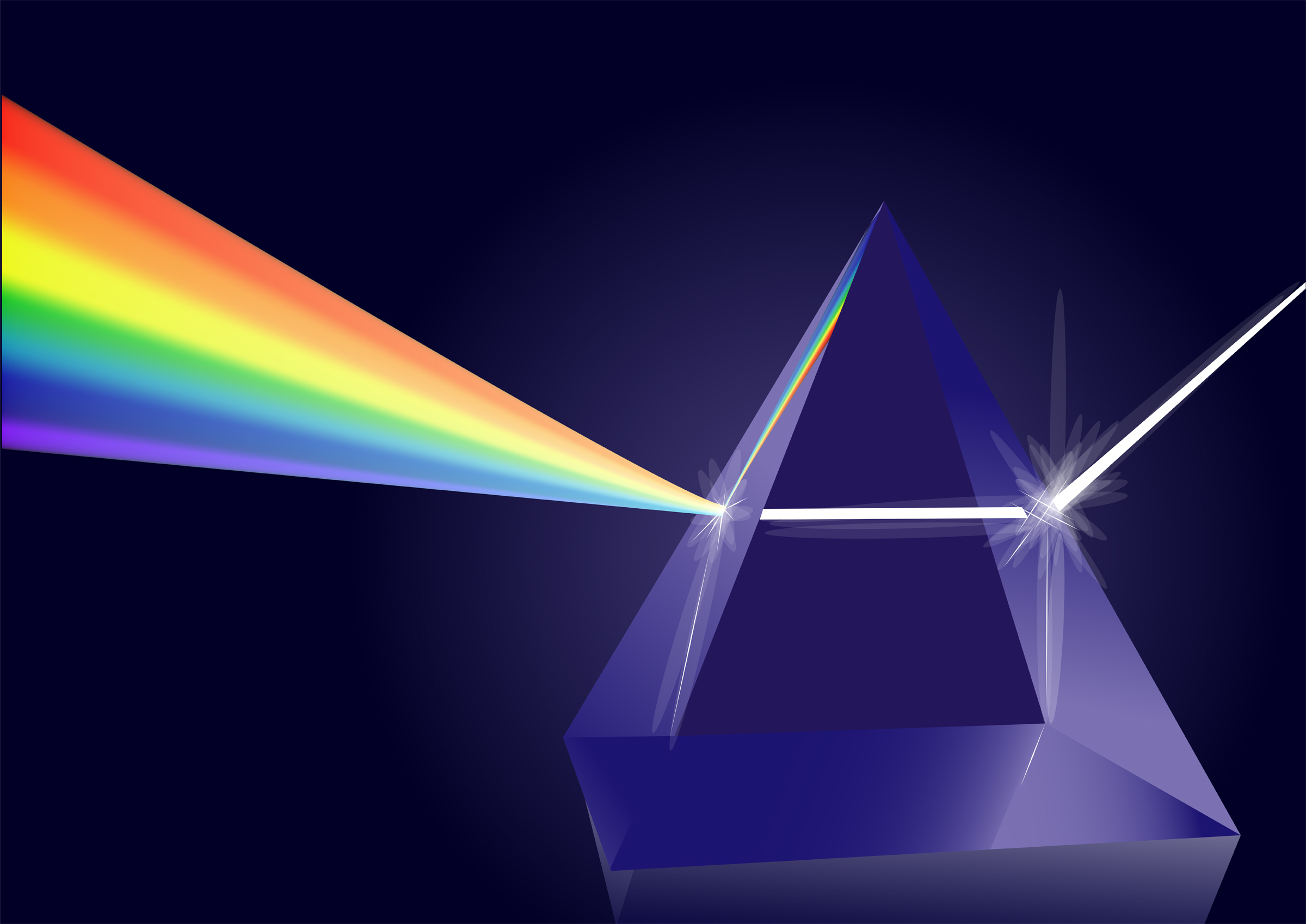
If you were to take a glass of water and insert an object (like a straw) into the water. When you look through the glass, you see the image of the straw.
The portion of the straw (still in the air) appears to be disjointed or disconnected from the portion that is immersed in water.
This distortion of the image (of the straw) is caused by a phenomenon called refraction.

Refraction is the bending of light (or any waves) as it passes from one medium to another because its speed changes.
For example, whenever light is passing through air, it travels through the air at a given speed (or velocity). However, whenever light is passing through water (in our example), then light travels at a different (slower) speed.
More about our Straw in the Glass of Water
When light travels from air into water, it slows down and bends towards the normal (an imaginary line perpendicular to the surface).
In Figure 1, I show an image of a light ray passing through air and entering the glass of water.
You can see (from this figure) that once the light ray enters the water, the light ray actually bends towards the normal (an imaginary line that is perpendicular to the surface of the water.
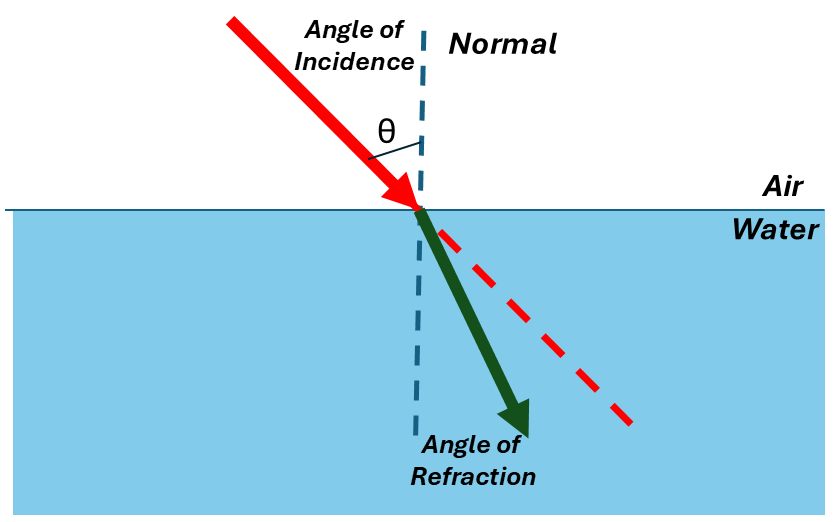
Figure 1, A light ray passing through air and entering water.
Conversely, whenever the light ray travels water, back to air, it (the light ray) speeds up and (once it enters the air, it bends away from the normal.
In Figure 2, I show an image of a light ray passing through water and entering air (above the water).
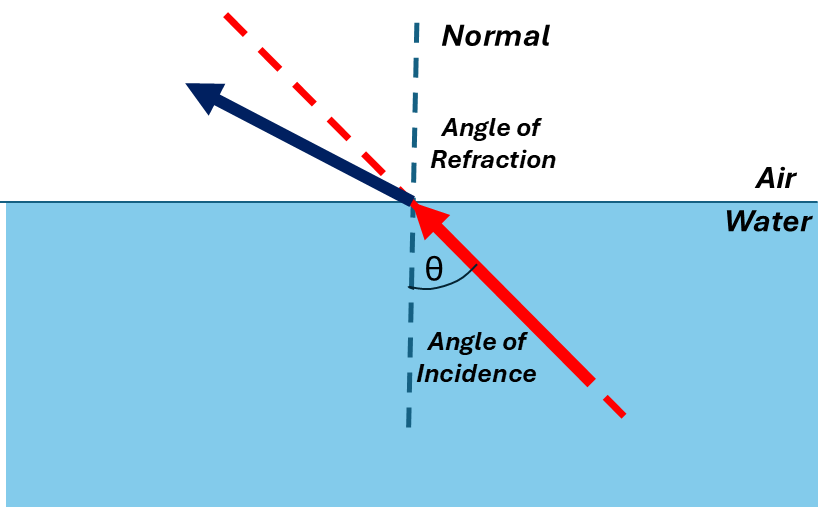
Figure 2, A light ray passing through water and entering air.
Can the Speed of Light Rays (in certain media) be quantified?
Yes, the speed (or velocity) of a light ray passing through a media can be computed via the following equation.
v = c/n
Where:
- v = the velocity of the light ray
- c = the speed of the light ray (in a vacuum – 3 x 10⁸ /sec)
- n = the refractive index (of the material that the light ray is passing through).
Therefore, if the refractive index for air is n(air), when the light passes through air, it will travel at a velocity v(air), where:
v(air) = c/n(air).
where:
- n(air) = the refractive index of air.
On the other hand, once the light ray enters water, then its velocity will change according to the following equation:
v(water) = c/n(water).
where:
- n(water) = the refractive index of water.
Putting in Some Real Numbers
n(air) = 1.0003 (but we’ll round it to 1.0) and
n(water) = 1.333
Therefore, whenever a light ray passes through air, it will be traveling at (essentially) at the speed of light (3 x 10⁸ m/s).
Whenever a light ray passes through water, it will be traveling at v = (3×10⁸m/s)/1.333 = 2.25 x 10⁸ m/s.
The concept of refraction and light rays traveling at different speeds (depending on the medium they are passing through) will be very important in fiber optic communication.
In another blog post, I will describe how the velocity (of a light ray) varies as a function of wavelength.