
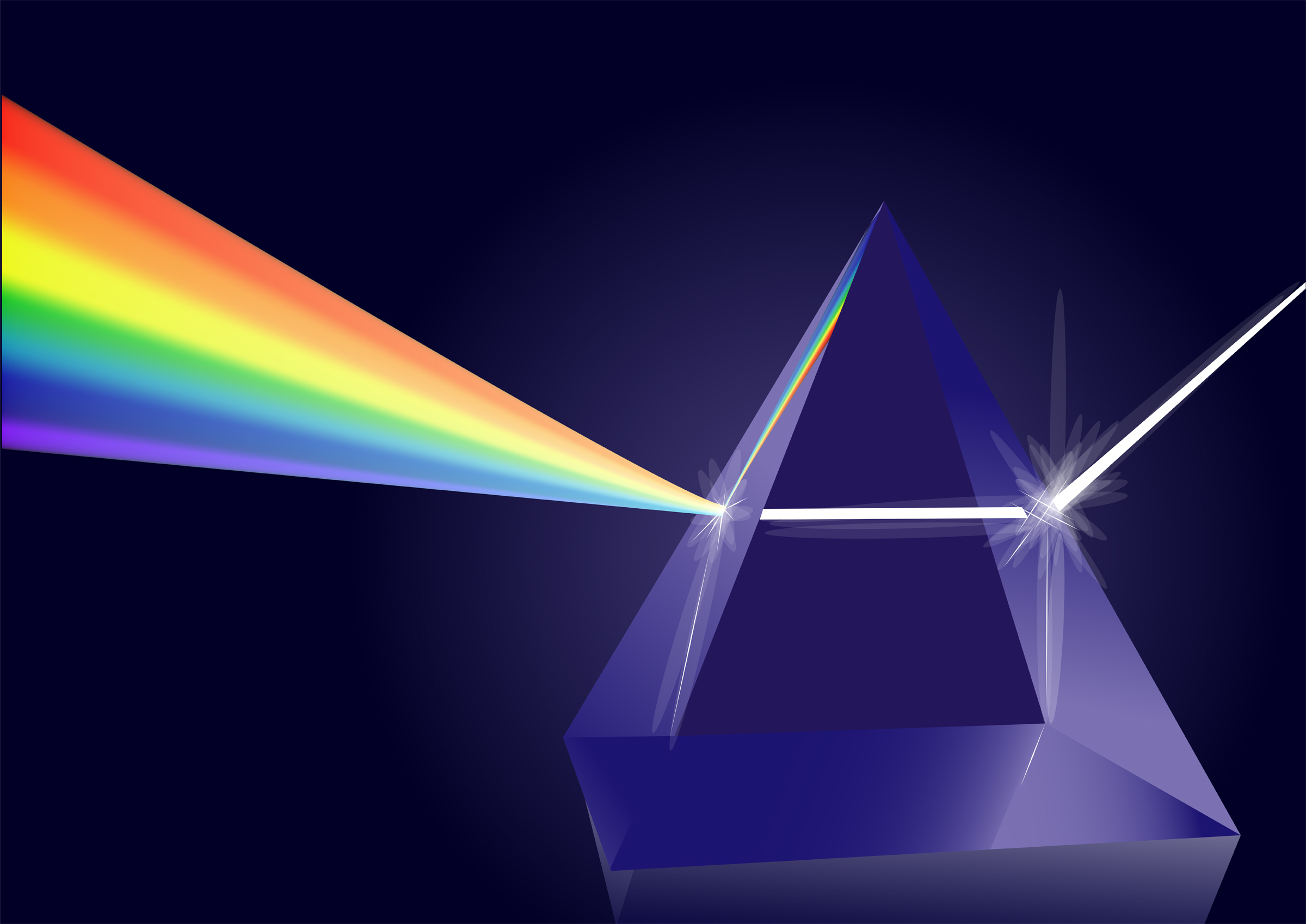
In another post, I mentioned that “refraction is the bending of light (or any waves) as it passes from one medium to another because its speed changes.
I further mentioned that “whenever light is passing through air, it travels through the air at a given speed (or velocity). However, when light is passing through water (in our example), then light travels at a different (slower) speed.
This change in speed causes the bending of the image (of a straw) in a glass of water.
The Refractive Index, n
I also briefly mentioned the “refractive index” in this same blog post.
The refractive index gives us a way to describe the speed of light when it passes through a given material or medium.
We can compute the relationship between a light ray’s speed through a given material or medium via the following equation:
v(material) = c/n(material)
Where:
c = the speed of light in a vacuum [n(vacuum) = 1.000]
n(material) = the refractive index of a material
v(material) = the speed of the light ray through this material.
What is the Refractive Index for Various Materials
The following table lists the refractive index for various materials, along with their corresponding speeds (or velocities) through these materials.
Table 1, Refractive Indices of Various Common Transparent Materials/Media
| Material/Media | Refractive Index | Velocity of Light Ray in Material (m/sec.) |
| Vacuum (Reference) | 1.0000 | 3.00 x 10⁸ |
| Air | 1.0003 | 2.99 x 10⁸ |
| Ice | 1.31 | 2.29 x 10⁸ |
| Water | 1.33 | 2.25 x 10⁸ |
| Ethyl Alcohol (Ethanol) | 1.36 | 2.21 x 10⁸ |
| Fused Silica (used in Optical Fiber) | 1.46 | 2.05 x 10⁸ |
| Acrylic (Plexiglass) | 1.49 | 2.01 x 10⁸ |
| Ordinary Window Glass | 1.50 – 1.52 | 2.00 x 10⁸ – 1.97 x 10⁸ |
| Crown glass (used in lenses) | 1.52 | 1.97 x 10⁸ |
| Polycarbonate | 1.59 | 1.88 x 10⁸ |
| Flint glass (used in optics) | 1.60 – 1.80 | 1.875 x 10⁸ – 1.66 x 10⁸ |
| Sapphire | 1.76 – 1.77 | 1.70 x 10⁸ – 1.69 x 10⁸ |
| Diamond | 2.42 | 1.23 x 10⁸ |
